How Do You Intercept a Dangerously Fast Drone?
You see a threatening unmanned aerial vehicle (UAV) heading towards your neighborhood at high speed.
What's the best strategy to neutralize it?
Simple. Take it down with a missile… Wait, that's too costly…
Another approach would be to use a relatively low cost drone to do a kinetic interception (collision).
But what exactly would you need to make it work?
First, you need to detect the position of the intruder.
That can be achieved with a ground radar monitoring the neighbourhood.
Aerial vehicles are composed of metals that can be detected with radars.
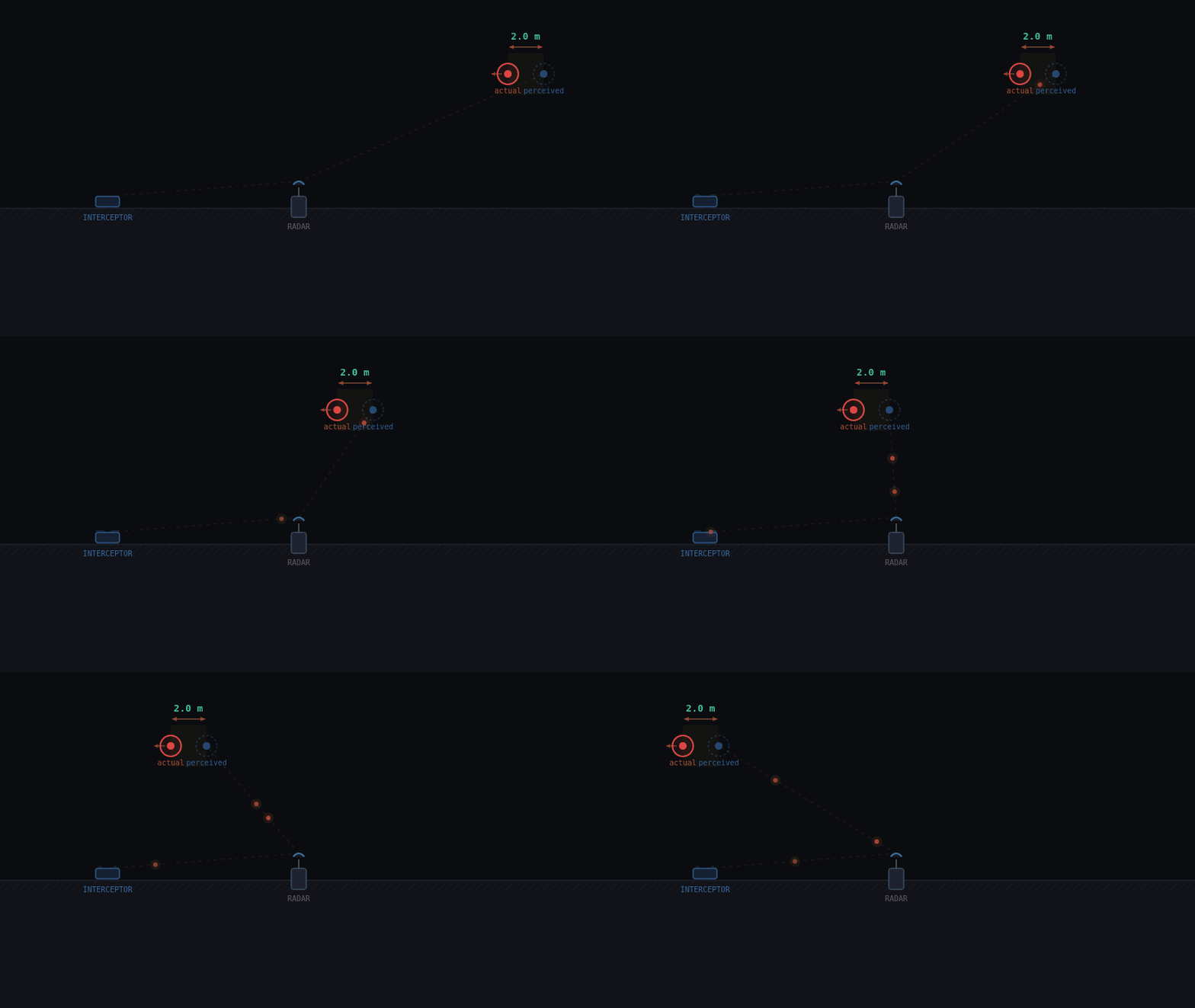
However, there is an issue… By the time the radar measures the target's position and that information reaches the interceptor, the target has already moved.
As you can see below, the higher the latency and the faster the target, the larger the gap between its estimated position and its actual position.
How can you correct that?
A simple approach is to assume the target moves at constant velocity and estimate where it will be 100 ms later, when the measurement finally reaches you.
Ok, nice, now at least you know where the intruder is approximately.
But how do you actually plan the interception?
One way would be to use a collision triangle.
Knowing the interceptor's maximum speed, the target's speed, and its direction of motion, you can compute the required attack angle.
Below you can see how it takes shape.
Challenge: Can you find at which speed and angle interception is impossible?
Great. Now you can activate full thrust and head towards the target fast.
Adjustments are needed along the way if the target slows down or if there is wind moving the interceptor.
Knowing the position of both the interceptor and the target from the radar helps you guide the interceptor in the right direction.
But…there is a big caveat here. Yes, you guessed it. Latency.
Radar gives us positioning but at the cost of latency which is ok for general direction but when the interceptor is closer to the target not so much.
You are rightfully suspicious here. It becomes very difficult to achieve a direct collision with a fast target using position estimates alone.
So what do you do?
You need to get rid of latency.
For that, there is only one option… having a sensor onboard the interceptor that can locate the target.
An event camera here could do the trick.
Because they detect changes in brightness at each pixel rather than capturing full images, they can operate at extremely high update rates.
Therefore, the relative position of the moving target to the interceptor is updated fast.
The interceptor can react quickly and adjust its direction.
How would that look in practice?
Pixels are detected in the camera frame and the interceptor must steer to maintain those events centered.
If the detected pixels are on the right, the interceptor should tilt right.
If they are left, it should tilt left.
When the detected pixels are centered, the interceptor is locked on the target and collision is imminent.
That's it. A three phase kinetic collision system.
Position the target in space. Align the interceptor towards it. Collide with a high frequency feedback loop.